
Suno Verse Tag Guide: How to Use [Verse] for AI Music
Master the Art of the Flow
Struggling with AI Music Verse and Chorus structure? The [Verse] tag is your primary tool for controlling vocal delivery, pacing, and narrative flow. While Suno excels at generating catchy Hooks, it often struggles to maintain a consistent story without explicit instructions—frequently resulting in “melodic sagging” or loss of rhythmic focus. By using these copy-and-paste prompts, you move beyond hoping for a good take and start directing the musical narrative, ensuring your lyrics hit with professional precision and keep your audience engaged from start to finish
Stop wasting credits on songs that sound the same from start to finish. Instead of just hoping Suno interprets your lyrics correctly, you’ll direct the musical narrative so every narrative shift keeps your audience engaged while you share your message with the world.
Verses: The Song’s Narrative
The Verse is the first step in the most important sequence in music: the Verse-Refrain-Chorus. While the Verse is responsible for telling the story, it works best when it leads the listener toward the big payoff. To keep your song from sounding messy, you need to tell Suno when the story is ending and when the catchy part is about to start.
Here’s the proper sequence:
[Verse] → [Refrain] → [Chorus]
Once your Verse finishes, use an optional Refrain to repeat a single important line before jumping into the energy of the Chorus.
Pro Tip
Understanding Verse Tags
Syntax is the key to professional song renders. Because Suno reads each input box differently, your tagging strategy must adapt to where you’re placing the code.
The Square Bracket Rule
- Lyrics Box: Commands require [Brackets]. Without them, the AI will attempt to sing your instructions as lyrics.
- Styles Box: Commands must be bracket-free. Adding brackets here can cause the model to ignore your genre or glitch the generation entirely.
The Lyric Trim Hack
We all know the industry standard: a classic rap verse is 16 bars. However, in the world of AI generation, there is a technical trade-off between length and delivery.
If you load a verse with 16 bars of text, the AI often reacts in one of two ways: it either delivers a “Double-Time” machine-gun wrap to fit it all in, or it starts to mumble and lose the rhythmic pocket entirely.
If you try to perform or sing a 16-bar block yourself at 140 BPM, you’ll realize how little breathing room is left. Suno feels that same pressure.
Why Less Is More
- The 30-Second Rule: A standard 8-line Verse typically adds about 30 seconds of high-energy audio to your track.
- The Focus Fail: If you push to 16 lines, you are asking Suno to maintain perfect rhythmic focus for a full minute. This is often where hallucinations or melodic sagging occur.
- Maximum Impact: To keep your (non-rap) track punchy and professional, aim for 4 to 8 lines per Verse. This allows the AI to prioritize swagger and attitude over just trying to get the words out.
If your song feels like it’s dragging or the vocals are getting mushy, start by cutting the Verse in half. You’ll find the AI hits the remaining lines with twice the intensity. Read the full Song Length Guide here.
Copy, Paste & Personalize
Copy & Paste: Click the Copy button on the Pink Box to grab the structural tags, then paste them directly into the Suno Lyrics Box.
Customize Variables: Once pasted, replace the tags with your own specific ideas. For example, you might choose a Dry, Melodic Vocals for a Pop song or Aggressive, High-Energy for rap or trap.
Add Your Content: Finally, insert your lyrics and add any remaining Intro, middle, and Outro tags to complete your track.
The Universal AI Music Verse Template
LYRICS BOX
[Verse: 1]
[Vocals: Modifier]
Your lyrics here...
Your lyrics here...
Your lyrics here...
Your lyrics here...
Your lyrics here...
Your lyrics here...
Your lyrics here...
Your lyrics here...

[Chorus]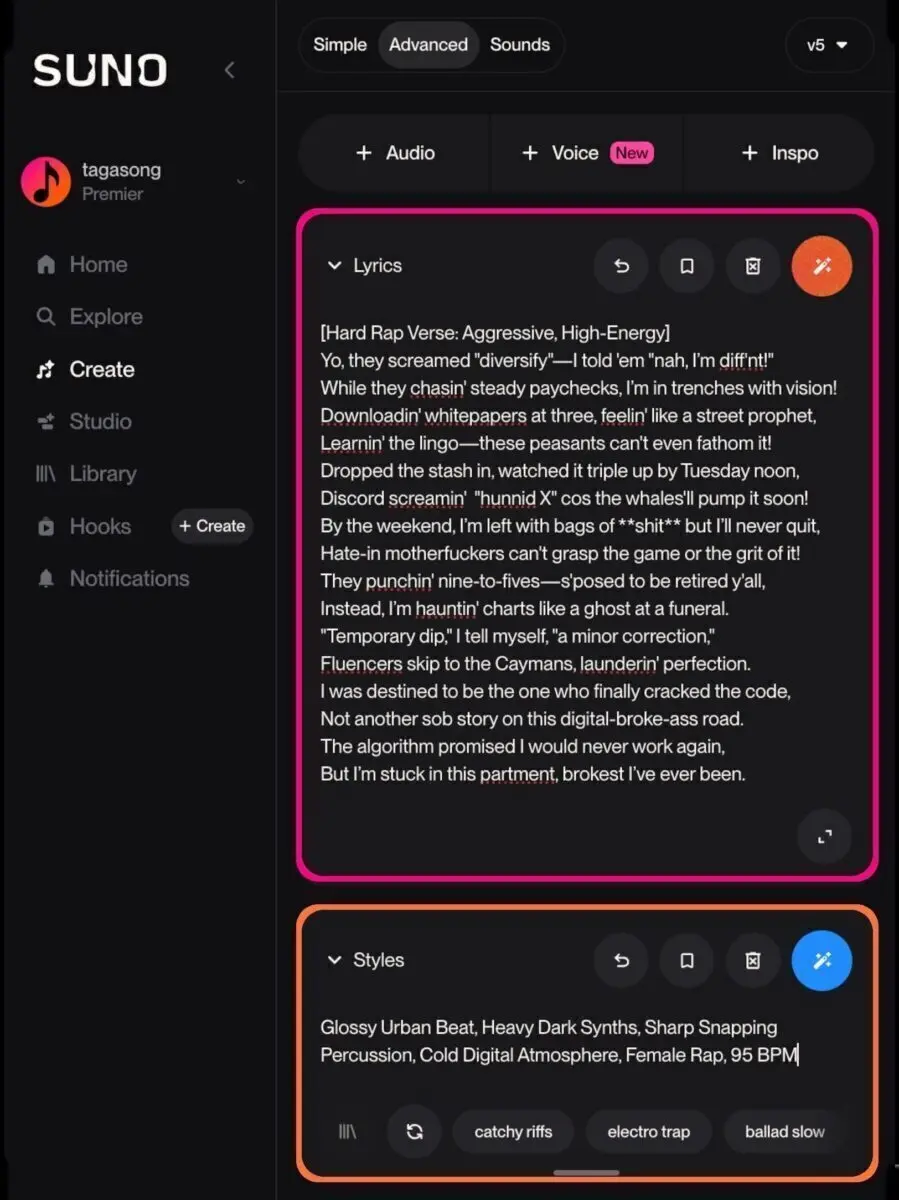
The Difference Between Verse 1 and Repeating Verses
Understanding the difference between your first Verse and the ones that come later is the secret to a successful AI song. Verse 1 acts like a vocal debut. Since the Intro is usually just music, the first Verse is where Suno decides exactly how your singer’s voice sounds and how they will deliver the story. In contrast, a repeating Verse like Verse 2 or Verse 3 is about consistency. It tells the AI to keep the same vocal style and apply it to new words so the song can keep moving forward.
Verses drive the storytelling, giving you the power to dictate exactly how the AI performs every word. Use phonetic spelling for slang or heteronyms (e.g. wind, tear) to keep the pronunciation locked in and professional.
The Suno [Verse] tags below are organized onto cards so you can find the exact delivery you need. Take a look at the categories, try out different tags, and see how they change the way your AI music tells your story.
Ranked [Verse] Tag List
Choose Your Narrative Element
Standard Verses
Prioritize the words and the message, creating a natural flow that lets your story take center stage.
[Verse]
The basic middle-of-the-road style.
[Melodic Verse]
The singer uses a tuneful, musical voice to carry the story before the big Chorus starts.
[Acoustic Verse]
Strips away the loud drums and electric guitars.
[Narrative Verse]
For longer, wordy stories (think Country or Folk).
[Short Verse]
Just 2 or 4 lines to get to the Chorus faster.
Vocal-Style Verses
Gives the singer a vocal costume to ensure the personality matches the music’s mood.
[Soulful Verse]
Deep emotion from joy to despair, often over-the-top delivery common in R&B, Soul and Jazz.
[Gritty Verse]
Adds distortion to the instruments and makes the overall track feel heavy and dark rather than clean and bright.
[Whispered Verse]
Very quiet and intimate great for ASMR or Lo-Fi Pop.
[Talk-singing Verse]
More like speaking than actual music. Like a vocal relief form the melodic cadence.
[Dynamic Verse]
Starts very quiet and gets louder at the end.
Pattern Verses
Controls how fast or slow each line hits the ear, making your song feel organized and professional.
PRO TIP
Try adding extra space between your syllables (like: Patter-n) inside the lyrics; this forces the AI to match the tag instead of rushing through the words.
[Call-and-Response Verse]
A main singer says something, and (a group answers.)
I want it all! (Everything)
[Staccato Verse]
Short, choppy words, or bro-ken flow.
[Monotone Verse]
A dominant trend in Post-Punk, Shoegaze, and Deadpan Indie. This pattern removes melodic inflection to create a detached, cool, or hypnotic atmosphere, forcing the listener to focus on the rhythmic pulse and lyrics.
[Echo Verse]
The AI repeats the last word of every line.
Rhythmic Verses
Treat your lyrics like a drum kit, snapping every syllable to the grid for maximum impact.
[Rap Verse]
The singer speaks along to the beat like a drum instead of singing musical notes.
[Melodic Rap Verse]
Half-singing, half-rapping (Modern Trap/Pop-Rap).
[16-Bar Verse]
In Hip-Hop, 16-bars is the magic number. It is long enough to tell a real story but short enough to keep the listener from getting bored before the next hook.
[Flow Verse]
Smooth, rhythmic rapping (Classic Hip-Hop).
[Rapid Verse]
Fast-talking, high-energy rapping.
[Double-Time Verse]
A staple in Rap and Drum & Bass. This command instructs the singer to perform at twice the rhythmic speed of the underlying beat, creating a sense of urgency and technical virtuosity without changing the song’s BPM.
[Syncopated Verse]
It is a purposeful emphasis on the unexpected parts of a beat.
[Staccato Verse]
Short, detached notes with lots of silence between syllables. Forces a choppy or robotic groove (common in Trap and Nu-Metal).
Suno [Verse] Tag Examples
Nicki Minaj – “MONSTER”
Nicki Minaj’s Verse on “Monster” is a masterclass in storytelling that managed to overshadow even the most established legends in Hip-Hop. Although she shared the track with heavyweights like Kanye West and Jay-Z, her performance remains the most memorable because of her incredible vocal range and versatility. By shifting seamlessly between a playful, sweet tone and a menacing, aggressive persona, she proved she was the most creative and fearless artist on the song. Her ability to command attention through pure technical skill and bold character work serves as a powerful example of how to truly stand out.
When a Monster Verse Stole the Spotlight: Engineering Nicki’s Characters

A single Verse can steal the show, but only if you structure your lyrics to force character shifts. In AI music, Hip-Hop is a fun but tricky genre to get right. If you aren’t specific about the vocal flow, the AI might just give you generic talking instead of a real rap rhythm.
To replicate that “Monster” energy—where the voice switches from a Barbie whisper to a Roman growl—you have to use Vocal Costume Tags within your lyrics.
How to Prompt the “Monster” Shift
To force Suno to move beyond a static delivery, use these technical injections:
- The Aggressive Foundation: Use
[Aggressive 808 Bass]and[Paced Vocal Delivery]in the Styles Box to set the floor. - The Tone Pivot: Inside the Lyrics Box, use bracketed commands to signal a personality change.
- Example:
[Vocal Shift: Playful, High-Pitch]for the Barbie setup, followed by[Vocal Shift: Menacing, Distorted Growl]for the Monster payoff.
- Example:
- The Roman Percussion: Use Internal Rhymes to act as a vocal drum kit, forcing Suno to snap every syllable to the grid.
- The iconic Monster growl: Try adding
[Vocal Style: Rasp, Aggressive Contralto]to your Lyrics box. This forces the AI to prioritize a thicker, more textured vocal tone.
While Nicki’s performance on “Monster” proves that vocal versatility can redefine a track, that level of narrative command isn’t just for show—it’s a mechanical necessity in genres where the lyrics carry the weight of the production.
AI Music Genres that Need Strong Verses
When you’re ready to tell your story, you want a genre that knows how to listen. In the AI world, some genres work much better with Verse tags because they were built to focus on the singer’s words and the flow of the music.
Here are some of them.
Hip-Hop (Boom Bap / Conscious)
While the Hook might get you to listen, the Verse is where the artist earns their respect. This genre relies on the Verse for lyrical dexterity, complex internal rhymes, and social commentary, often spanning 16 or more bars.
- Why it works: The Verse acts as a rhythmic percussion instrument in its own right, driving the track’s momentum through flow and cadence rather than melody.
- Tag strategy: Combine
[Verse]with descriptors like[Complex Rap Flow]to prevent the AI from becoming too melodic or sing-songy in the delivery.
Folk and Americana
In these genres, the Verse is the sacred ground for storytelling. The music often stays intentionally simple—acoustic guitar or piano—to ensure that the listener’s focus never drifts from the lyrical narrative.
- Why it works: The repetitive, rhythmic nature of the Folk Verse creates a hypnotic state that allows for deep emotional connection and complex storytelling.
- Tag strategy: Use
[Acoustic Verse]or[Storyteller Verse]to keep the instrumentation sparse, ensuring the AI emphasizes vocal clarity over production flare.
Country
Country music is built on the “three chords and the truth” philosophy. The Verse is where the specific details—the who, what, and where—are established, making the generalized anthem of the Chorus feel earned.
- Why it works: It utilizes a very specific narrative structure (AABB or ABAB) that provides a comfortable, familiar framework for listeners to follow the story of the song.
- Tag strategy: Use
[Narrative Verse]followed by specific instrumental cues like[Pedal Steel Fill]to add authentic flavor between the vocal lines.
Progressive Rock
In the world of Prog, the Verse is often a shifting landscape. It serves as the experimental Bridge between complex instrumental movements, often changing time signatures or textures to reflect a changing mood.
- Why it works: It challenges the listener by subverting the expectation of a standard Pop structure, using the verse as an evolving journey rather than a static repetition.
- Tag strategy: Try using
[Atmospheric Verse]with time signature cues like[7/8 time]to push the AI toward the more complex arrangements typical of the genre.
Beyond the Verse
Next Steps: Control the Narrative
The Verse is where you build the world of your song. It’s the subtractive space that gives your lyrics room to breathe before the energy spikes. A great Verse isn’t just a filler—it’s the strategic setup that makes the next section feel earned. Depending on your song’s structure, here is where you head next:
For the Big Payoff: Move to the Chorus Tag Library to anchor your story with soaring vocals, wide stereo imaging, and a full-spectrum Wall of Sound.
For the Emotional Shift: Head to the Bridge Tag Library to learn how to break the pattern with a new melody or a sudden change in perspective. The Bridge is a tension-builder, and that tension demands a specific type of resolution. It sets the stage for your track’s final act.
Feeling overwhelmed by all the options?
Don’t sweat the theory. If you’ve got a specific artist or mood in mind, let Vibe-to-Tag engineer the perfect Suno Lyrics tags and complete Styles box for you instantly.
One click, zero stress.