
Suno Drop Tag Guide: How to Use [Drop] for AI Music
Master the Art of Impact
Struggling to make your AI tracks hit harder? The [Drop] tag is the ultimate tool for engineering high-impact, professional payoffs. While generative models often treat a transition as just another line of text, a well-engineered AI music Drop forces Suno to shatter the tension and release a massive burst of energy. These tags turn your arrangement from a linear, flat loop into a visceral, club-ready banger.
Stop gambling with your credits and start taking control of your AI music. Instead of crossing your fingers and hoping for a good result, you’ll be the one telling Suno exactly when to stop the climb and release the pressure.
Drops: The Ultimate Payoff
The Drop is the final destination of the Build-Break-Drop sequence. To get a professional, hard-hitting result, you shouldn’t slam into a Drop; you need to prepare Suno for the inevitable impact. Using a strategic pause right before the Drop ensures the AI initializes the new section with maximum volume and rhythmic weight.
Here’s the proper sequence:
[Build] → [Break] → [Drop]
If your Drops feel cluttered, you’re likely missing the gap. Visit our Break guide to learn how to optimize your transitions, and revisit the Build page to make sure you’re creating enough tension to justify the hit.
Pro Tip
Understanding Drop Tags
Syntax is the key to professional song renders. Because Suno reads each input box differently, your tagging strategy must adapt to where you’re placing the code.
The Square Bracket Rule
- Lyrics Box: Commands require [Brackets]. Without them, the AI will attempt to sing your instructions as lyrics.
- Styles Box: Commands must be bracket-free. Adding brackets here can cause the model to ignore your genre or glitch the generation entirely.
The Impact Buffer Hack
A Drop is the ultimate musical payoff in AI music engineering, marking the moment where rhythmic tension is released into a high-energy climax. It serves as a structural pivot that typically shifts the track from a sparse or building section into a dense, full-frequency instrumental or vocal hook.
Never slam a Drop directly into a wall of text. Forcing Suno to transition instantly from dense lyrics to a high-energy climax often results in a thin sound where the sub-bass fails to initialize properly.
To fix this, you must engineer an Impact Buffer. By inserting a specific Break tag from our library with one empty line before and after the tag, you clear Suno’s audio buffer. This gap provides the necessary processing space for the AI to reset its internal gain and load the full frequency payload of your Drop.
Copy, Paste & Personalize
Copy & Paste: Click the Copy button on the Pink Box to grab the structural tags, then paste them directly into the Suno Lyrics Box.
Customize Variables: Once pasted, replace the tags with your own specific ideas. For example, you might swap a Heavy Bass Drop for the generic Drop or a Stop-Start Stutter Build instead of a double Start-stop.
Add Your Content: Finally, insert your lyrics and add any remaining Intro, middle, and Outro tags to complete your track.
The Universal AI Music Drop Template
LYRICS BOX
[Build]
Your optional lyrics building tension...

[Break]

[Drop]
[Instrumentation: Full Band Entry]
[Instrumentation: Layer 1]
[Instrumentation: Layer 2]
[Vocals: Modifier]
Your high-energy lyrics here...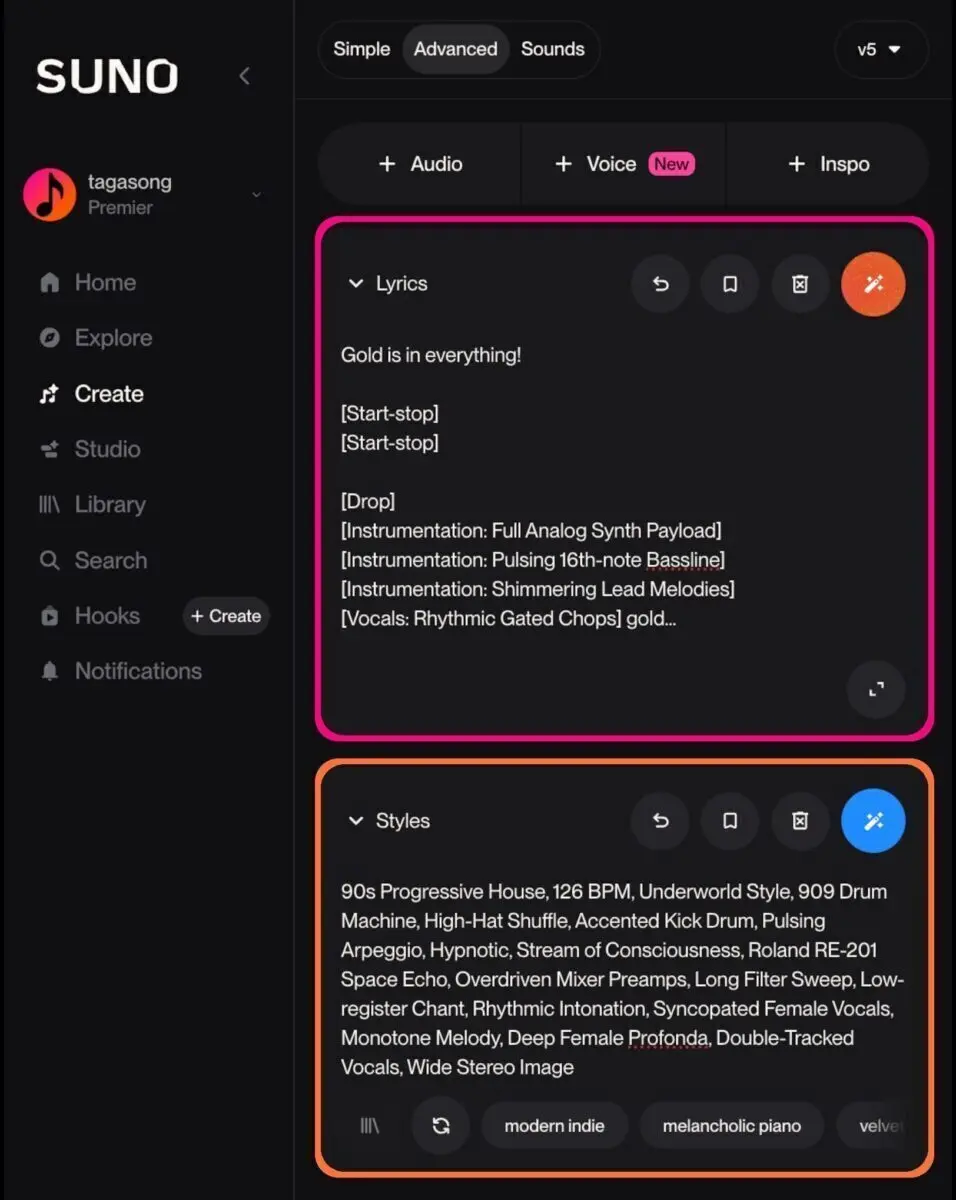
The Difference Between Opening Drops and Mid-Song Drops
Understanding the difference between an Opening Drop and a Mid-song Drop is the secret to creating a satisfying resolution. An Opening Drop acts as a high-energy handshake, forcing Suno to skip the ramp-up and initialize the song’s full power, tempo, and rhythmic weight from the very first second. In contrast, a Mid-song Drop is about managing the payoff. It takes the accumulated pressure from your Build and commands the model to shatter the tension, releasing a burst of energy, bass, and volume.
A Drop Intro is about identity—telling the AI exactly how hard this song is going to hit from the start. A Mid-song Drop is about resolution—telling the AI that the anticipation is over and it’s time to deliver the “Big Moment.”
The Suno [Drop] tags below are organized onto cards so you can find the exact vibe you need. Take a look at the categories, try out different tags, and see how they change the way your AI music drops!
Ranked Mid-Song [Drop] Tag List
Choose Your Favorite Impact
Power Drops
Power Drops create the classic EDM explosion with full bass, full drums, and high energy.
PRO TIP
Try [Drop: Full Band Entry] to ensure the AI triggers every instrument at once for maximum impact.
[Full Band Entry]
Commands the AI to bring back the drums, bass, and leads simultaneously.
[Explosive Drop]
Forces a high-decibel, high-energy arrival with heavy compression.
[Power Drop]
Signals a massive shift in sonic density. It tells the AI to fill every frequency—sub-bass, mid-growls, and high-end sizzle—all at once.
[VIP Drop]
A more aggressive and complex variation of the main theme.
Bass Drops
Bass Drops focus entirely on the low-end and are usually found in Trap, Dubstep, or Metalcore.
PRO TIP
In Suno, the [808 Drop] tag works best if you mention Sub-bass in your style prompt to give the AI the right frequency to work with.
[808 Drop]
Triggers a long, sustained electronic bass hit common in Trap and Hip-Hop.
[Heavy Bass Drop]
A general command to prioritize low-end frequencies at the transition.
[Sub-bass Impact]
Focuses on the felt vibration rather than the heard melody.
[Wobble Bass Drop]
Triggers a rhythmic, oscillating breathing”effect on the low-end. Use this to add movement and bounce to the transition.
Pop Drops
Pop Drops are a Post-chorus instrumental melody that takes the place of a vocal Hook.
PRO TIP
Use these after a Chorus to give the singer a break while keeping the energy high with a catchy instrumental melody.
[Pop-drop]
A modern transition into an instrumental hook rather than a vocal one.
[Vocal Chop Drop]
Commands the AI to slice up vocal samples into a rhythmic melody.
[Synth Hook]
Forces a new, catchy synthesizer theme to take the lead.
[Rhythmic Groove Entry]
Commands a sudden shift into a driving, percussive rhythm with a prominent bassline. Use this to ensure the track doesn’t just arrive, but immediately starts to dance.
Anti-Drops
Anti-drops are a trendy subversion where instead of getting louder, the music suddenly gets quiet and minimal.
PRO TIP
This works best in emotional Pop or Deep House; use it to surprise the listener by leaning out the sound when they expect a lean in.
[Anti-drop]
A sudden reduction in energy where the beat becomes minimal or disappears.
[Minimal Drop]
Strips the track down to just a basic kick or a simple synth line.
[Subtle Texture Drop]
Removes the rhythm but leaves atmospheric shimmers or pads behind.
Suno [Drop] Tag Examples
Knife Party – “Bonfire”
Wobble bass is the oscillating, rhythmic heart of Dubstep Drops, characterized by a low-frequency oscillator (LFO) that modulates the filter or volume of a bass synth.
Knife Party’s “Bonfire” is arguably one of the most aggressive and iconic Drops in modern electronic music. Starting with a high-tension reggae-infused vocal Build, it suddenly pivots into a relentless, high-speed Drum-and-Bass rhythm that hits with the force of a physical punch. We’re sharing the video so that you can clearly hear the 174 BPM escalation that leads up to this epic Final Drop.
The Aggressive Bounce: Recreating the Knife Party Sound

To replicate the “Bonfire” signature, you need more than just a loud bass—you need a high-velocity transition followed by a Drop that feels wide and mechanical. Because this sound is built on a 174 BPM foundation, your tags should prioritize speed and saturation.
Structural Requirements
- The Build: Use
[Reggae-to-Drum-and-Bass Transition]and[Rising White Noise]to prime the AI for the sudden shift. - The Drop: Immediately follow with
[Drop: Aggressive Growl Bass,Industrial Percussion], and[174 BPM]to force the high-speed rhythmic intensity.
Key Sound Profiles
[Saturated Lead Synth]Commands the AI to use heavy distortion on the main melody, giving it that gritty digital edge.[High-Speed Drum Break]Forces the complex, fast-paced percussion patterns characteristic of modern DnB.[Mechanical Snarl]Triggers the aggressive, almost robotic bass textures found at (00:59) in the video.[Vocal Chop Intensity]Signals the AI to rhythmically slice the reggae vocals into the high-speed Drop.
Why it works: The secret to the Knife Party sound is the Reggae-to-Riot pivot. By starting with a melodic, organic Build and dropping into a distorted, industrial Drop, you create a psychological shock that makes the track feel more powerful than it actually is.
Suno is widely considered one of the most capable models when it comes to Dubstep (or in this case Drumstep). Because the AI is trained on high-energy electronic music, it excels at interpreting the complex, growling textures and aggressive rhythmic shifts that define the genre.
The reason Suno handles these Drops so well is that it understands the mathematical relationship between a high-tension Build and the subsequent sub-bass explosion. When you provide the right structural cues, the model is excellent at delivering the high-contrast payoff you expect from a professional Dubstep track.
AI Music Genres that Feature Drops
For the best results with the Break tag, choose genres famous for high-energy tension and release. These styles emphasize the contrast between silence and sound, making it easy to hear exactly how a well-timed pause transforms a track from amateur to professional.
Here are some of them.
EDM (Electronic Dance Music)
The modern definitive home of the Drop, spanning sub-genres like Dubstep, Trap, and Big Room House, where a heavy bass-driven climax follows a rhythmic buildup.
- Why it works: It creates a physical release of energy that drives dance floor engagement by contrasting high-frequency tension with low-frequency bass impact.
- Tag strategy: Use a Build for 8-16 bars followed immediately by
[Drop]or[Bass Drop]to trigger the heavy synth entry.
Hyperpop
Known for its maximalist production, this genre often features sudden, abrasive, and high-energy Drops that shift the song texture from sugary-sweet to distorted and chaotic.
- Why it works: The jarring shift mirrors the internet-age aesthetic of information overload, keeping the listener in a state of constant surprise.
- Tag strategy: Combine
[Glitch]or[Silence]tags just before the[Drop]to maximize the perceived volume and chaos of the shift.
Nu-Metal
Often utilizing a quiet-loud dynamic, this genre features heavy Drops where the tension of a melodic Verse releases into an explosive, distorted guitar and drum Chorus.
- Why it works: It mimics the emotional arc of repressed tension finding a cathartic outlet through aggressive instrumentation.
- Tag strategy: Use a Bridge with melodic descriptors followed by
[Heavy Drop]and[Distorted Guitars]to ensure the transition is felt.
Future Bass
This genre focuses on melodic, synth-heavy Drops that use modulated wobble chords and lush textures to create an emotional and rhythmic peak.
- Why it works: It prioritizes atmosphere and melody over pure aggression, allowing the Drop to feel uplifting and cinematic rather than just percussive.
- Tag strategy: Place
[Soaring Synths]and[Rhythmic Pulses]within the Drop section to guide the AI toward the specific melodic wobble characteristic of the genre.
Trap
This genre focuses on rhythmic tension and sub-bass impact, using high-velocity percussion stacking and minimalist gaps to create a hard-hitting transition.
- Why it works: It leverages the contrast between rapid-fire rolls and heavy, sustained low-end, allowing the Drop to feel physically powerful and spacious rather than just cluttered.
- Tag Strategy: Place
[Stacking Hi-Hat Rolls]and[Layered Snare Riser]in the Build, then lead into a[Power Drop]with[Heavy 808 Sub-Bass]to ensure the AI hits the low-end with maximum weight.
Beyond the Drop
Next Steps: Command the Impact
The Break has cleared the deck and primed your listener’s ears. Now it is time to deliver the payoff. A Drop isn’t just a louder section; it’s a structural shift that dictates how the AI re-initializes its audio engine. Depending on your genre, choose the high-energy landing that fits your track:
For the Final Closure: If this was your track’s peak, visit the Outro Tag Library to engineer a definitive cold stop or a circular loop that keeps the listener on repeat.
For Sustained Climax: Move to the Chorus Tag Library to anchor your drop with soaring vocals and a full-spectrum Wall of Sound.
For the Cool Down: Head to the Verse Tag Library to learn how to transition from a high-energy drop back into a stripped-down, rhythmic narrative.
Feeling overwhelmed by all the options?
Don’t sweat the theory. If you’ve got a specific artist or mood in mind, let Vibe-to-Tag engineer the perfect Suno Lyrics tags and complete Styles box for you instantly.
One click, zero stress.